Why Your Gums Bleed When You Floss
If you’ve ever flossed and noticed a little pink in the sink, you might have thought:
"Maybe I’m flossing too hard."
"Maybe flossing just makes my gums bleed."
"I’ll stop for a few days and try again later."
You’re not alone — bleeding gums are one of the most common things I hear about as a dental hygienist.
But here’s the truth: healthy gums should not bleed when you floss. Bleeding is usually your body’s way of telling you that there is inflammation happening along your gumline.
The good news? In many cases, bleeding gums can improve with consistent, proper flossing.
Let’s talk about why it happens and what you can do.
The Most Common Reason Your Gums Bleed: Inflammation
Your mouth is full of bacteria (that’s normal!), but when plaque sits along your gumline, your body recognizes those bacteria as something it needs to fight.
This triggers an immune response, causing your gums to become:
Red
Swollen
Tender
More likely to bleed
Think of it like a tiny cut on your skin. If you keep irritating that area, it becomes inflamed and sensitive. Your gums respond in a similar way.
Bleeding is often a sign that your gums need more consistent cleaning — not less.
“But My Gums Only Bleed When I Floss… Should I Stop?”
This is probably the biggest misconception I hear.
Many people stop flossing because they see blood and assume they are causing damage.
Usually, the opposite is true.
When you stop flossing, plaque and bacteria continue to build up between your teeth. This can lead to more inflammation and more bleeding over time.
Instead of avoiding the area, think of flossing as helping your gums heal by removing what is irritating them.
Am I Flossing Too Hard?
Yes, it is possible to floss too aggressively.
Flossing should not feel like you’re “scrubbing” your gums or snapping the floss into the tissue.
The goal is not to force floss between your teeth — the goal is to gently clean the sides of each tooth.
A proper flossing technique looks like this:
Use about 18 inches of floss.
Gently guide the floss between your teeth.
Wrap the floss around one tooth in a “C” shape.
Slide it up and down along the side of the tooth.
Repeat on the other side.
Your gums may bleed at first if they are inflamed, but with daily cleaning, that bleeding should gradually decrease.
How Long Does It Take for Bleeding Gums to Stop?
Everyone is different, but many people notice improvement within 1–2 weeks of consistent flossing.
The key word is consistent.
Flossing once a week usually isn’t enough to keep inflammation away. Plaque bacteria are constantly building up, so your gums need regular care.
Think of flossing like brushing your hair — doing it occasionally doesn’t have the same effect as making it part of your routine.
Other Reasons Your Gums Might Bleed
While plaque buildup is the most common cause, bleeding gums can also be related to:
Hormonal Changes
Hormone shifts during your menstrual cycle, pregnancy, or other changes can make gums more sensitive.
Certain Medications
Some medications can affect your gums or increase bleeding tendencies.
Smoking or Tobacco Use
Tobacco use can impact your gum health and healing.
Nutritional Deficiencies
Certain vitamin deficiencies can contribute to gum problems.
Gum Disease
Persistent bleeding, swelling, gum recession, or bad breath can be signs of gingivitis or periodontal disease and should be evaluated by a dental professional.
When Should You See a Dentist or Dental Hygienist?
Occasional bleeding that improves with better flossing habits is usually not a reason to panic.
However, it’s a good idea to get checked if you notice:
Bleeding that continues after several weeks of proper flossing
Gums pulling away from your teeth
Loose teeth
Persistent bad breath
Pain or swelling
Pus around the gums
Your gums are connected to your overall health, and catching problems early makes treatment much easier.
The Bottom Line: Don’t Let Blood Stop You From Flossing
If your gums bleed when you floss, your first instinct might be to avoid that area.
But bleeding is often your gums asking for more attention, not less.
Consistent brushing, daily flossing, and regular dental cleanings can help reduce inflammation and get your gums back to a healthier state.
Your gums should not bleed forever — but they do need consistency to heal.
How to start healing your bleeding gums:
It’s all about consistency. It is important to brush 2x/day and floss daily with tools that work for your specific mouth...especially when you have active infection going on. Follow recommendations curated for your mouth specifically (adjunct hygiene tools and recare frequency play a huge roll) to get the results that you are trying to acheive. Hygiene is not one size fits all unfortunetly.
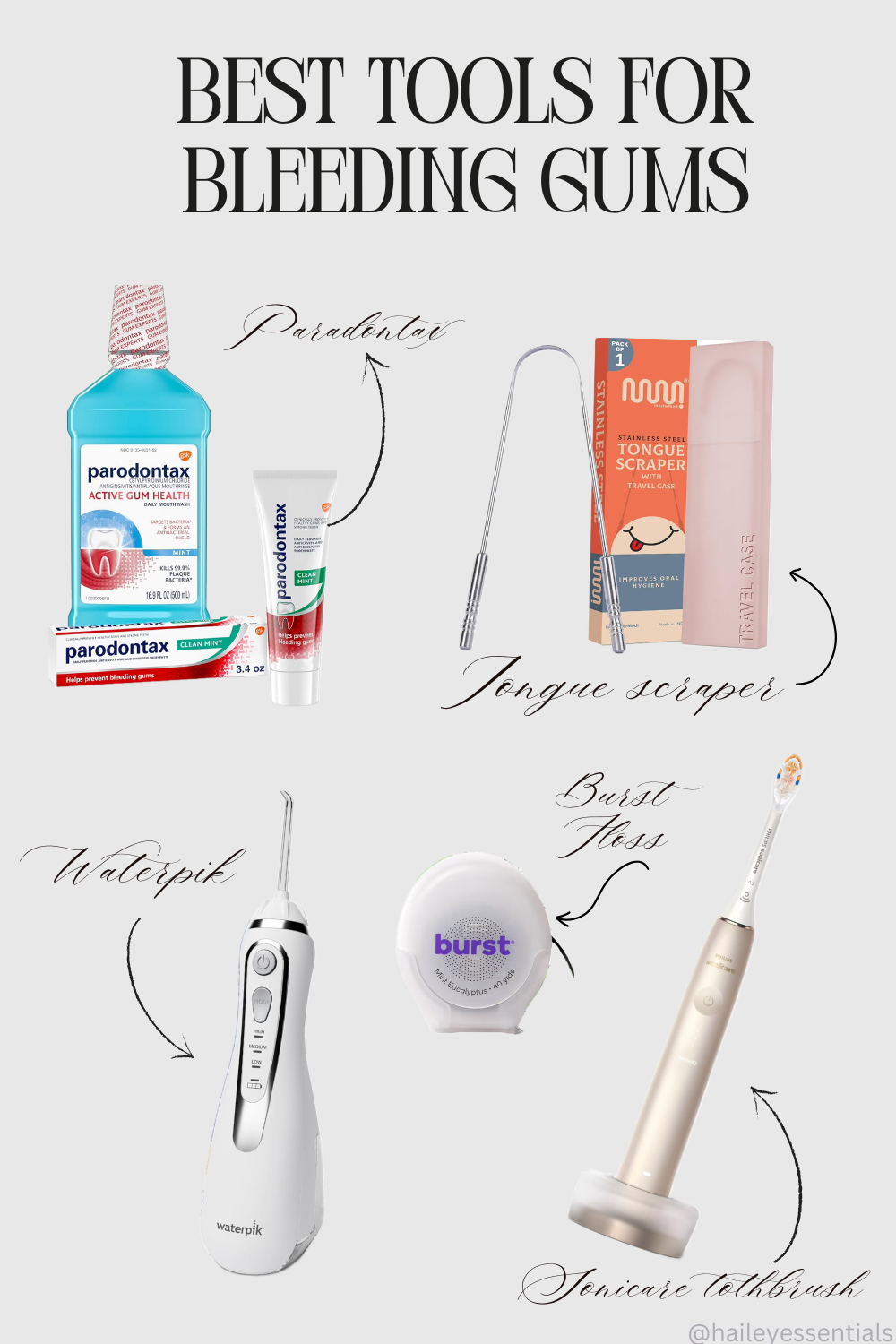
Here are my favorite products to use if you are experiencing bleeding gums:
1 — waterpik ($99 on amazon)
A waterpik helps get further below the gums to help disrupt that bateria that is causing the inflammation. Regular floss and a toothbrush get 1-3mm below the gums… the waterpik can get 6mm below the gums when used properly. If you are noticing inflammation and bleeding it is common to have 4mm or greater pockets so a toothbrush and floss will not cut it. You need something that will get deeper. Go to waterpik.com to see some helpful videos to make sure you are using it properly. They also have a cordless waterpik which is great for travel and you can even use it in the shower!
Directions: Start on low power for first use. Turn unit on when it gets in correct spot in mouth. Slightly open mouth and look in sink (not in mirror or you will make a mess) Angle 90 degree towards tooth right at gumline. Pause in between each tooth for 30 seconds and move tip from tooth to tooth. With each use, slowly turn power up, the goal is to get to the higher power setting so it can effectively flush out deeper.
2 — Electric toothbrush ($49.99 on Amazon)
An electric toothbrush is one of the most efficient and effective ways to remove plaque. It moves much faster than your hand can. The vibrations help push the toothpaste in between the teeth and deeper below the gums.
Directions: Hold on tooth, angle at 45 degree towards gumline. Move very slowly brushing all tooth surfaces. Do not scrub like you would with a manual toothbrush you want to let the toothbrush do the work and allow the vibrations to have some time to work on each tooth.
3 — Woven floss ($6 burst floss on amazon)
If you have more sticky stubborn plaque you may need a thicker floss to help remove the plaque effectively.
Directions: I always wrap floss around my pointer and middle finger. Pull floss tight when wiggling it between your teeth then loosen up to allow the floss to expand when it is in between the teeth. Wrap the floss in a C-Shape scrubbing up and down about 3x per tooth going below the gums as far as you can without forcing it. Pull it tight again to pull it out and continue throughout mouth. Don’t forget the back side of your last molars.
4 — Tongue scraper ($6 on amazon)
The tongue holds so much bacteria which can also contribute to inflammation in the mouth. The tongue is made up of something much different than your teeth which is why I like to use a separate tongue scraper designed specifically to get in all of the papilla on my tongue to ensure I get all of the bacteria trapped inside. I also like this supermouth tongue scraper
Directions: stick tongue out start at back of mouth and pull forward to remove bacteria. Rinse and continue until tongue is clean.
5 — Paradontax ($8 on Amazon)
This is a specific formulated toothpaste for bleeding gums. It helps reduce bleeding gums by 30% alone when using consistently for 12 weeks. Great if you feel like you need some extra help. It targets the specific bacteria causing inflammation/bleeding. They also sell a mouthwash
Directions: Brush with at least 2x/day for 12 weeks to notice a difference
About the Author
Hi, I’m Hailey —I’ve been a dental hygienist for 7 years. I love sharing practical, hygienist-approved tips to help you feel confident taking care of your smile. My goal is to break down dental care in a simple, realistic way and help you understand what’s actually happening in your mouth. I am super passionate about Oral Hygiene Instructions and love when patients realize they can help stop progression of gingivitis and gum disease with the right tools.